
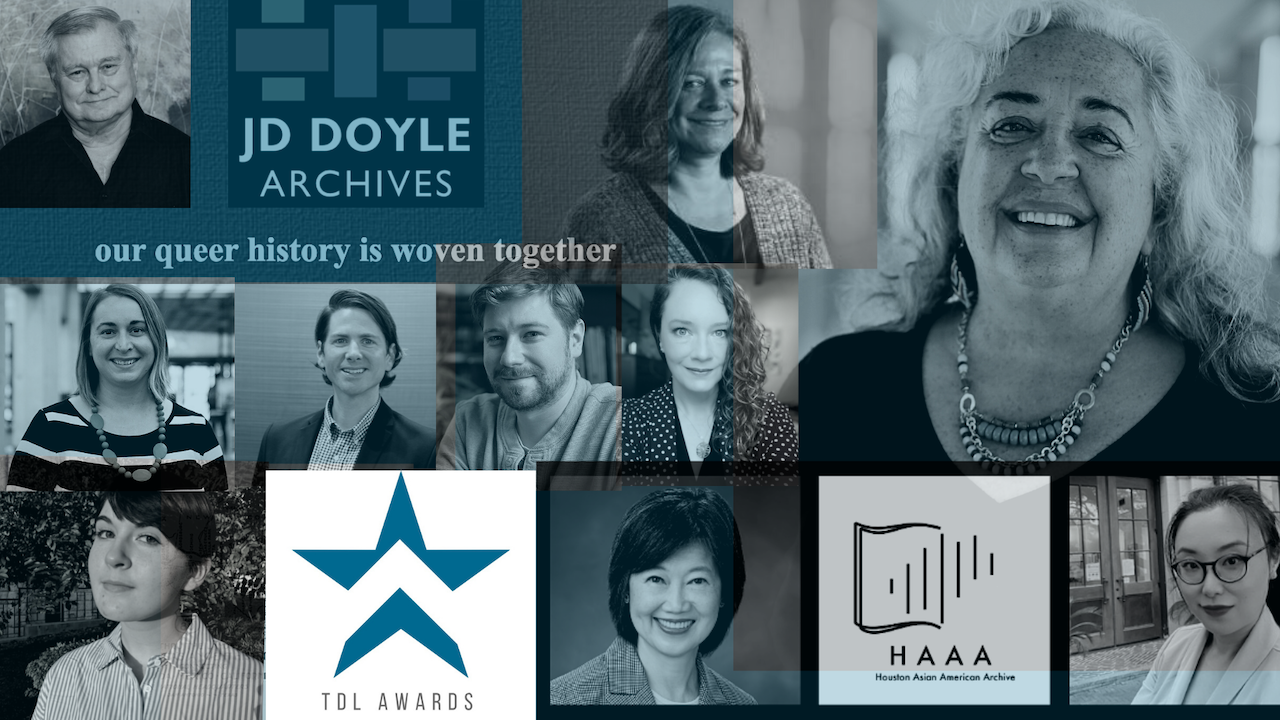
The 2021 awards winners represent a variety of institutions and projects. Archivists, digital scholarship, and open access champions at academic libraries and community archives from around Texas are among this year’s winners, showcasing the cross disciplinary and inter-institutional partnerships that libraries and archives leverage so well.
Texas Digital Library is proud to present this year’s TDL Award Winners, accompanied by their nominations.
Excellence Award | Trailblazer Award | Outreach Award | Student Excellence Award | Scholarly Communication Award | Individual Impact Award | TDL Service Award
Excellence Award | Houston Asian American Archive at Rice University
The TDL Excellence Award honors a specific project that demonstrates overall excellence in one or more areas of digital library practice.
The winner of this year’s Excellence Award is the Houston Asian American Archive at Rice University.
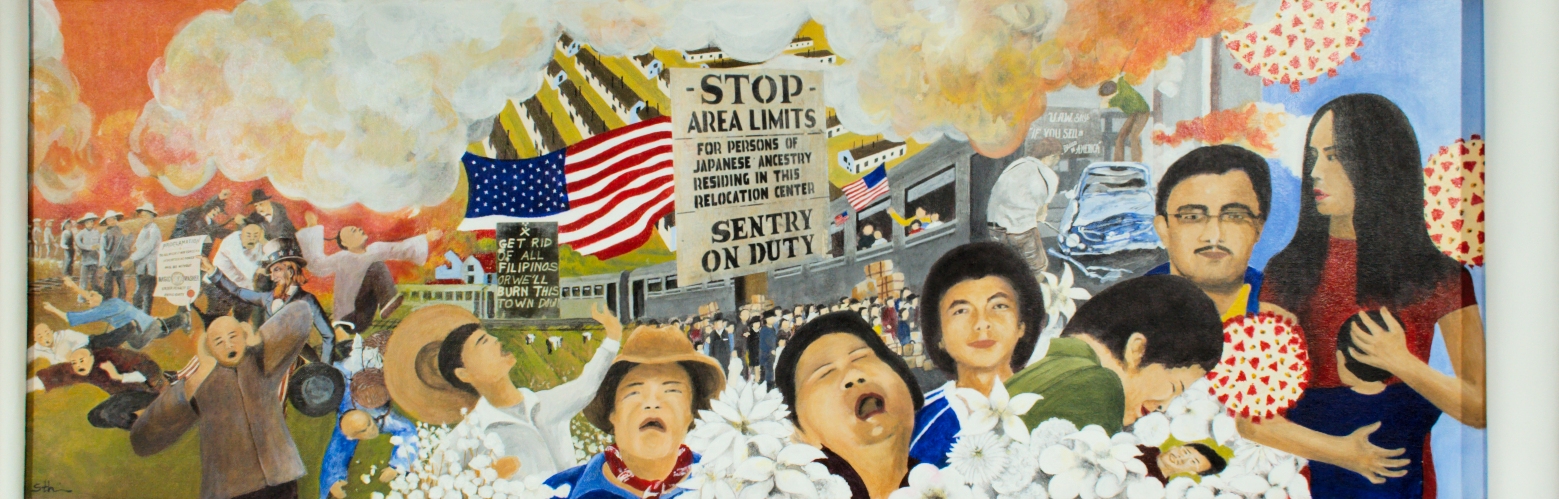
Forgive But Not Forget (2020)
Acrylic on Canvas, 48 x 18 in.
Donated by the artist.
Location: Woodson Research Center, Fondren Library, Rice University.
By Ann Shi, Associate Curator, Houston Asian American Archive
During the year of 2020, COVID pandemic struck the world and many are dealing with anxiety, stress and pain. The Houston Asian American Archive (HAAA) initiated a series of projects to respond to and archive human experiences, and provide a space of communal archive of stories, emotions, and healing, for the Rice community and beyond.
The HAAA is a digital scholarship project managed by Chao Center for Asian Studies, residing in Fondren Library, Rice University in 2010. HAAA is co-founded and managed by Dr. Anne Chao, adjunct faculty at the Department of History and Board of Trustees at Rice University. For over a decade, many scholars and talents have contributed to the success of the archive: Professor Tani Barlow, who helped conceive the project; Amanda Focke, Director of the Special Collection of the Woodson Research Center at the Fondren Library, is the Archivist of HAAA, who has meticulously and patiently catalogued our interviews and donated materials for eleven years; Katherine Shen, a volunteer who ensures that the interns ask the right and in-depth questions. Ann Shi, associate curator, whose vision for the archive to be more than a repository of oral interviews, and who gave color, imagination, and artistic direction to the archive.
In April 2020, the COVID-19 special collection‚ COVID Chronicles, was initiated to collect stories in the Asian American community about their experiences in and actions taken to fight the pandemic and protect others. To honor those who have been exerting themselves with an exceptional work ethic in this unprecedented situation, we have collected the stories of frontline workers, community leaders, volunteers, advocates and many others. We have also compiled interviews into playlists on our social media platform:
Salute Asian American Heroes: a curated collection to honor those who contributed in the health crisis.
COVID Chronicles: a broad-based collection for stories and experiences in the pandemic.
In June, the Racial Justice & Civic Engagement special collection was started to document stories and discussions about Black Lives Matter movement and other racial justice topics, as well as civic engagements on voting rights and its pressing matters before the election. This will be a collection ongoing as well as revisited in every election cycle.
“Dear Houston — Love, Asian America,” was started in February 2021 as an extension of the special collections, which focuses on Asian American’s love stories. It was initially inspired by the love-at-first-sight story of Beck Hong Gee (which was released on a Valentine’s Day podcast directed by Ann Shi). Two HAAA interns, Sarah Kong and Helen Pu, both started their own oral history projects, the former on Asian food oral history, the latter on the networks of Chinese Christian Churches, will form upcoming episodes in this podcast.
In addition to oral histories, art has been invited to the Archive to further the mission of HAAA and to embody the voices in oral histories. Two public exhibitions, “Faces in the Pandemic” and “Portal of Healing: Crossing the Bridge Together” were curated by Ann Shi in fall 2020 and spring 2021. Both were community projects with open calls to engage the public, encouraging them to share their stories with the archive. In “Faces in the Pandemic”, portraits of 120 volunteers were mounted onto a narrow hallway in the Fondren Library, whose intense gazes created questions about their identities in diaspora. Ten Asian and Asian American artists made works during and in response to events in the pandemic to give voices to the Asian American community.
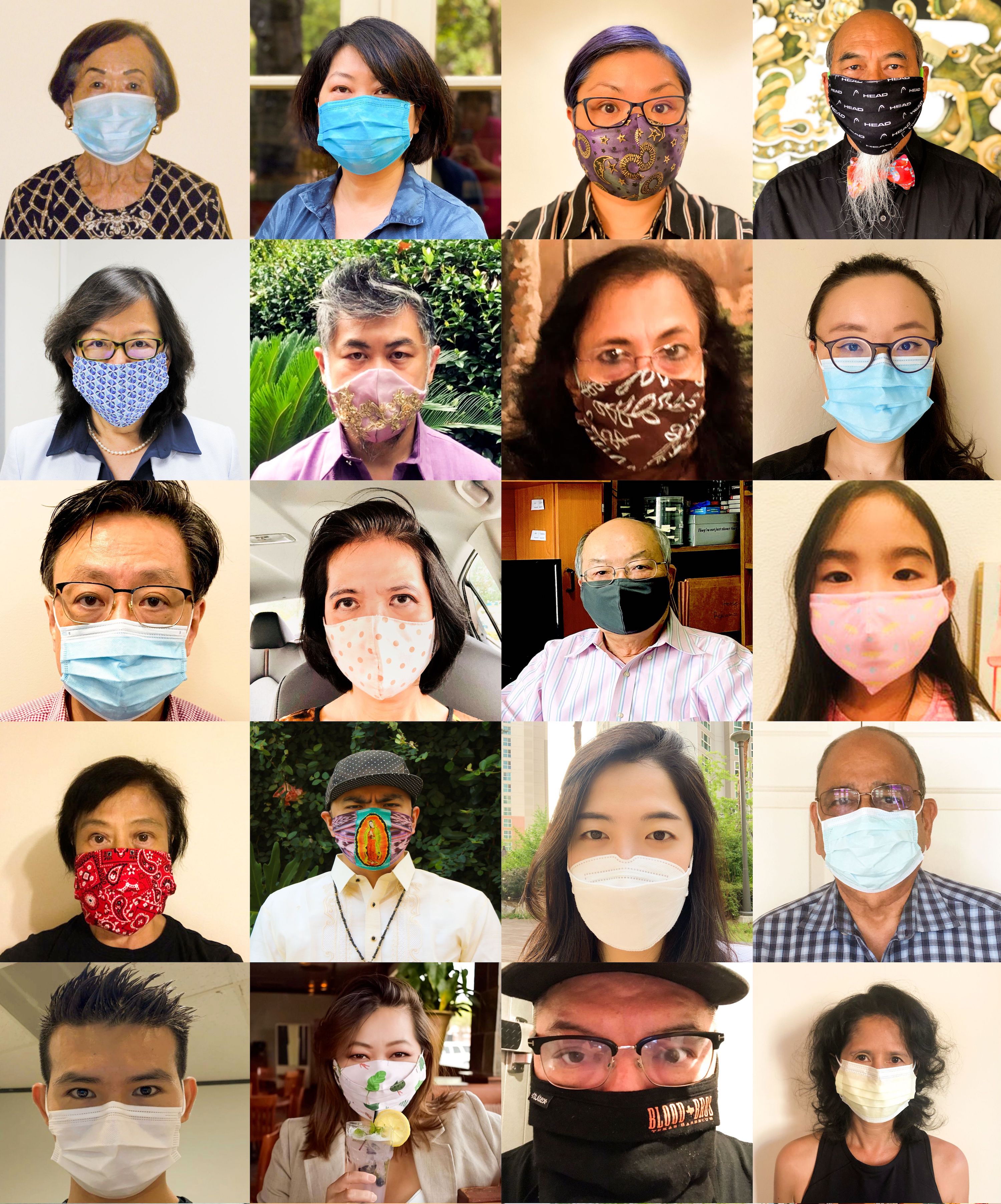
Photo collage in 10 Panels, 48″ x 69″ each.
Courtesy of all 120 Volunteers
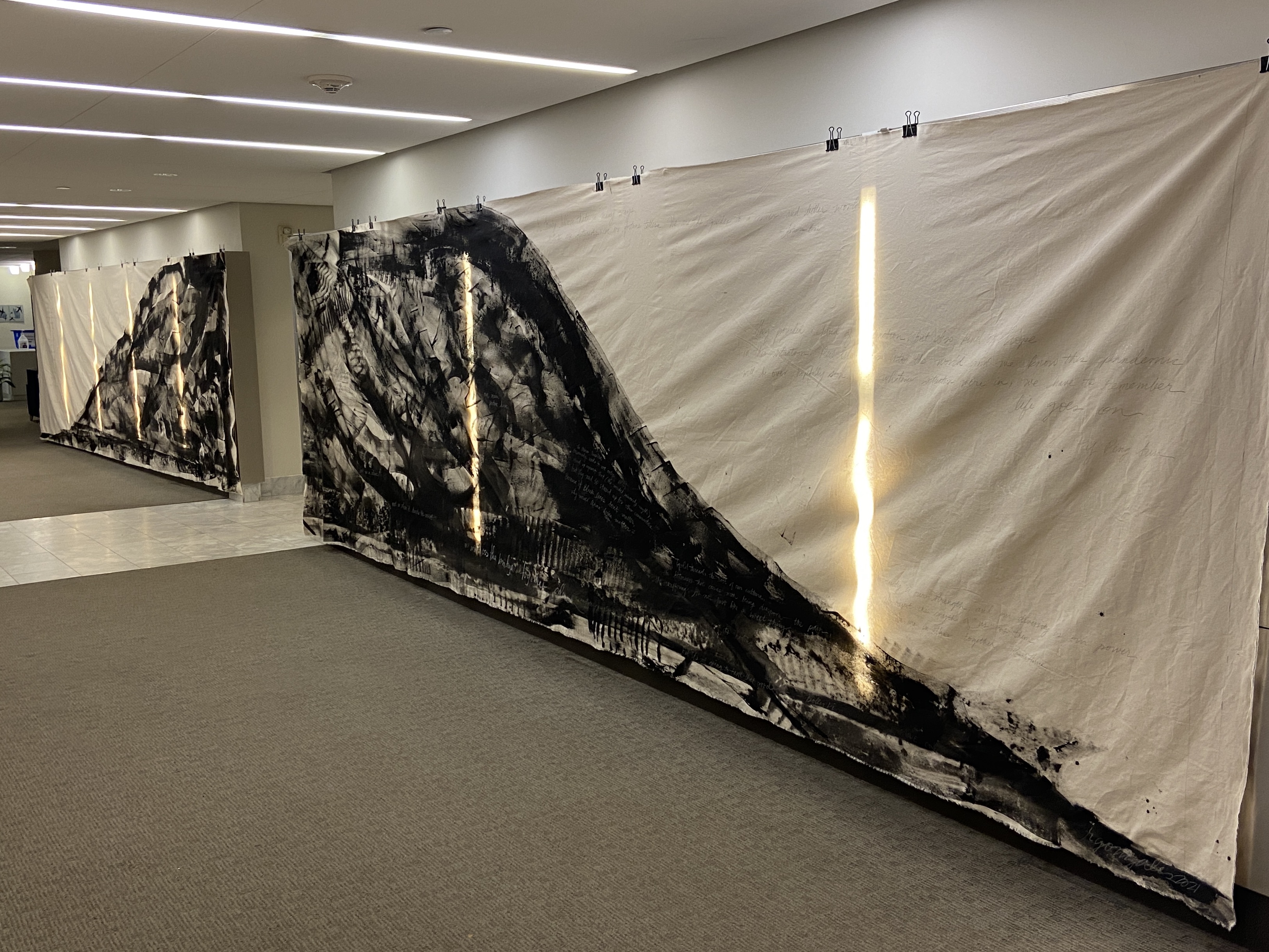
In “Portal of Healing: Crossing the Bridge Together”, of which the planning started in October 2020, again, open calls were casted for Asian American community to submit creative writings in the theme of grief, healing, human strife, and condolences. Working with Flipina American gestural painter, Rice Architecture School alumni, Rachel Gonzales, the HAAA interns led by Ann Shi, weaved out quotes from HAAA interviewees along with the open call submissions which included two poetries, one specifically made for the exhibition. Rachel inscribed these words in her calligraphy onto the immersive art installation. A performance on video by Rea Sampilo, manifesting the female body, the vitality of humanity, painted the air as a brush in the space of healing, embodying the experiences of the pandemic told by the voices in the oral history. The exhibition cohesively threaded the SallyPort of Rice campus, the space framed by feminist painter Dorothy Hood’s two ceiling-tall gestural canvases, and the Twilight Epiphany by James Turrell, symboling the endless tunneling of the healing energy into the female body, the female womb, and to the cosmic womb into the universe of the Skyspace. (Exhibition materials can be found here.)
For these contributions, I would consider HAAA worthy of nomination for the Excellence Award, and would appreciate the consideration from Texas Digital Library.
Trailblazer Award | JD Doyle Archives
The Trailblazer Award honors the work of an individual or group within a Texas academic library who has used limited resources in innovative ways to create, maintain or support digital collections.
This year’s winner of the Trailblazer Award is the JD Doyle Archives.
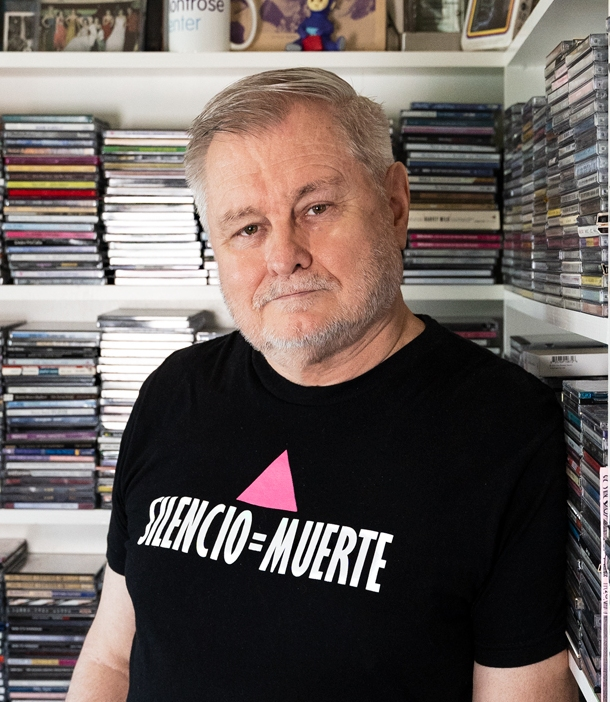
By JD Doyle
The JD Doyle Archives is a culmination of twenty years of work preserving LGBT history, in three different areas, and totaling over 18,000 web pages of content.
First was Queer Music Heritage, a radio show running from January 2000 until March 2015. It was both a radio show and a website, and the goal of both was to preserve and share the music of our culture. Each month’s page gives the playlist and additional pages of info, and you can stream or download every show. Although the programming has stopped the site will continue as a resource for the history of LGBT music. Over 580 hours of programming are archived. Covering almost every area of music, it documented the presence of LGBT musicians and singers, and their recordings, and this was done not only with monthly shows but visually showing images of the people, the albums, CDs, tapes, even 78 rpm records dating back to the 1920s, so a visual and audio history.
Special focus was always on music that was lyrically gay, telling our stories, documenting our histories, be it coming out, celebrating our pride, or mourning our losses to AIDS, with many theme shows covering different areas. Interviews with many of our musical pioneers were part of the series, some of whom are sadly now deceased. Special attention was shown to Women’s Music and that of Transgender artists. I wish I had had competition, as there is plenty of history to share, but this was the only radio show or website trying to capture and share the history of our music.
Under the QMH umbrellas was a second internet radio show, OutRadio, which satisfied my need to also showcase ‚ recent artists, again with many interviews allowing them to tell of their musical journeys. And also on the site are the episodes of Audiofile. That was a monthly music review segment carried by the radio newsmagazine This Way Out, lasting 14 years, from 1997 through the end of 2010. All segments are archived.
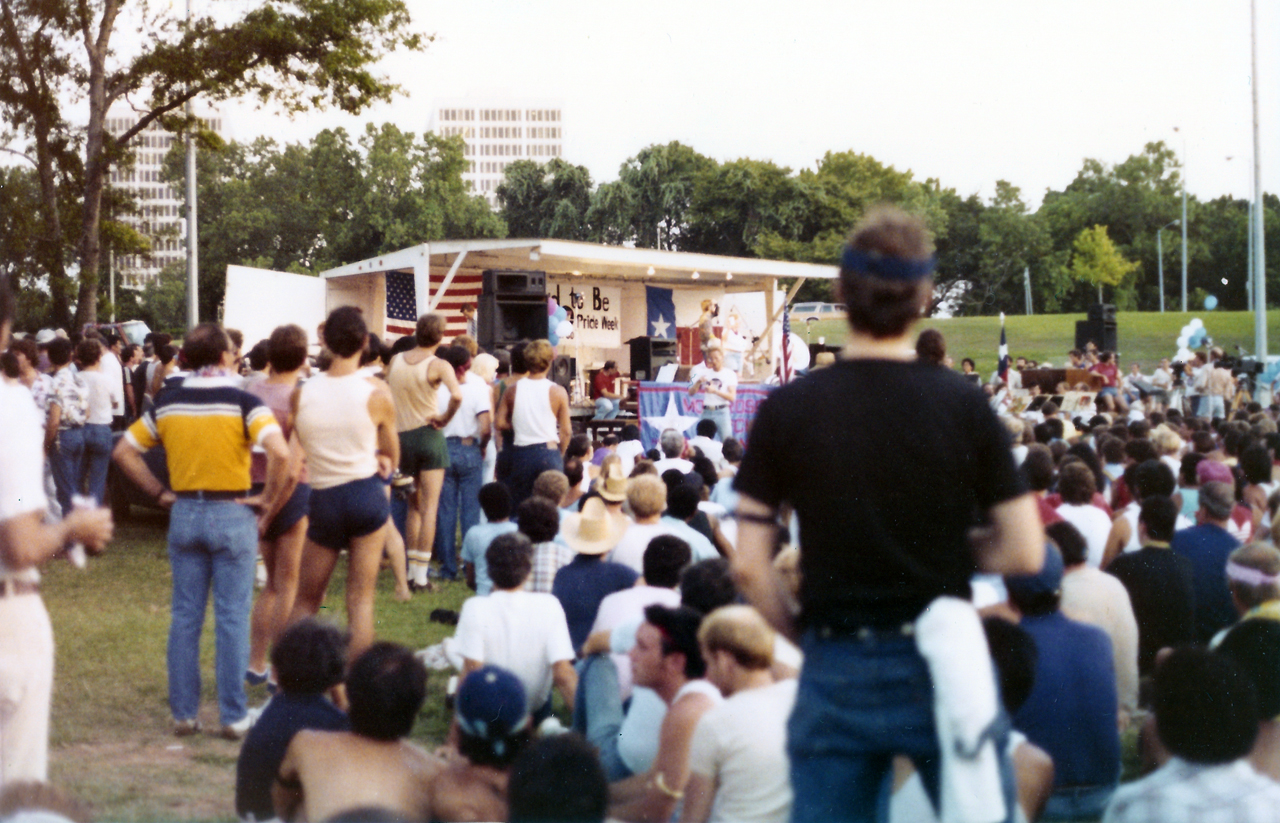
From the start I found my QMH site a place to share the extensive information I have on Female Impersonation, mostly vintage, and including a music discography of those singing drag queens. There is a wide variety, including drag scrapbooks, sheet music, club programs, postcards, and memorabilia. It is itself one of the largest resources on the internet of this area of the culture.
QMH101.com is a special project of my radio show and website Queer Music Heritage. It was designed as sort of a study guide, or lesson plan, and the hope was for it to appeal to those LGBT Studies courses now found at many universities around the country. I recognized that the music history was missing from most courses, and decided to make filling that need possible. A number of professors of those courses have reported back to me of the successful use of that project.
I have always been interested in others queer history areas, but around 2014 I felt the need to close down the (very time intensive) radio efforts in order to devote my energies to two other areas. So next was the website Houston LGBT History, which (still growing) is a resource of mostly Houston history, but also ample areas of Statewide focus, like gay & lesbian publications of Dallas, Austin, San Antonio and other Texas cities. My digital publication efforts have been ambitious, including (just one example) digitizing all 1518 issues of the statewide magazine This Week in Texas (1975-2013), which in a way covered the cultural lifeblood of gay life in the state.
Separate sections of that site cover my Three P’s: Publications, Politics and Pride, and they and others on Bars, Businesses, Organizations, Events, People and more display thousands of clippings from the publications, organized chronologically to enable logical research in many areas of the culture. I have often been told by writers that they could not have done an article on our history that they had published without my site as a resource.
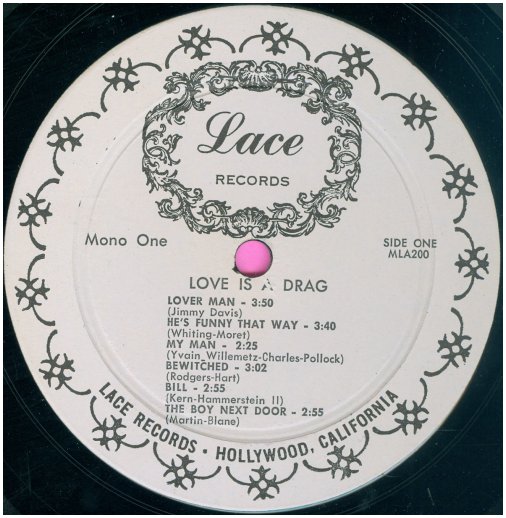
The History site is also host to a project that is both a pop-up museum of Houston LGBT history and an organized website. The Banner Project has a striking visual display that is used annually at the University of Houston and it has been featured at a number of galas and events. It is found at HoustonWeHaveHistory.org, which includes essays on the subject of each banner.
A third large and growing resource is the Texas Obituary Project, a searchable database showing obituaries (from gay publications and a variety of sources) for those LGBT Texans we have lost. Of course a large percent of the almost 7500 obituaries were due to AIDS, but there is no criteria on the cause of death, and entries are coded with tags (AIDS, violence, Black, Latino, female, and now, COVID). So, a researcher could look for the number of AIDS deaths in Dallas in 1993, or chart the deaths due to violence (whether gay-bashing/murder or in a relationship). In 2018 the Houston Chronicle did a front-page article on this website, which also captured the poignant means that it has given many people closure in mourning their loved ones.
In 2019 I was notified that the Library of Congress has selected my websites for inclusion in the materials related to LGBTQ+ studies. I am very honored by this, as it means my work will be preserved long into the future.
I hope by example my work demonstrates to other historians and archives ways to capture, organize and display specific histories. Although not affiliated with the University of Houston, I work closely with representatives of their LGBT Resource Center, and often borrow and digitize publications from their collection, making the files available online generally for the first time. And I make frequent donations of materials to their holdings.
Outreach Award | UT El Paso Institute of Oral History
The Outreach Award honors an individual or team that demonstrates a creative and successful approach to reaching new users and building awareness of an organization’s digital library.
The winner of this year’s Outreach Award is the UT El Paso Institute of Oral History.
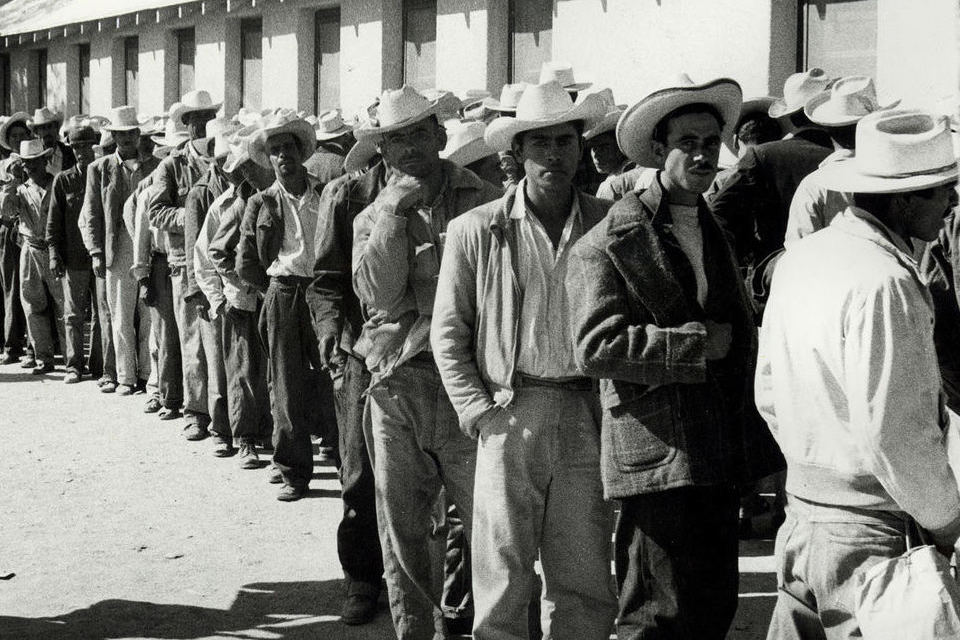
(Photo Courtesy of USCIS History Library)
By Yolanda Leyva, Associate Professor of History, Department of History, UTEP
I am pleased to nominate The University of Texas at El Paso (UTEP) Institute of Oral History (IOH) for the Texas Digital Library Outreach Award. The IOH is the largest repository of border-related oral histories in the United States. In the past three years, Dr. Meredith E. Abarca (affiliated faculty) and the IOH team created three video projects based on oral histories with the goals of reaching a broader audience and informing people about our digital collection. The videos have reached a wide audience as evidenced by the number of views on our platforms, which include Vimeo, YouTube, and a website dedicated to Dr. Abarca’s project, El Paso Food Voices. Links are below, following this narrative.
The IOH and Special Collections of the UTEP Library have collaborated for decades to make our oral histories accessible through the library. Early on, students and community members visited the Library in person to access transcripts and audio. Beginning in 2009, the Library began to provide access to our collection through a searchable database, first Digital Commons and now Scholar Works. It has been a very fruitful collaboration. Last year, people downloaded our oral histories 22,232 times.
Scholars and students have consulted our collection extensively over the past five decades to write about border history, immigration, Mexican Americans, West Texas, and historical events such as the WWII-era Bracero Program. We are dedicated to expanding our audience to the broader public and K-12 educators and for the past several years we have sought creative ways to makes the stories in our collection accessible to these audiences by creating video projects available online.
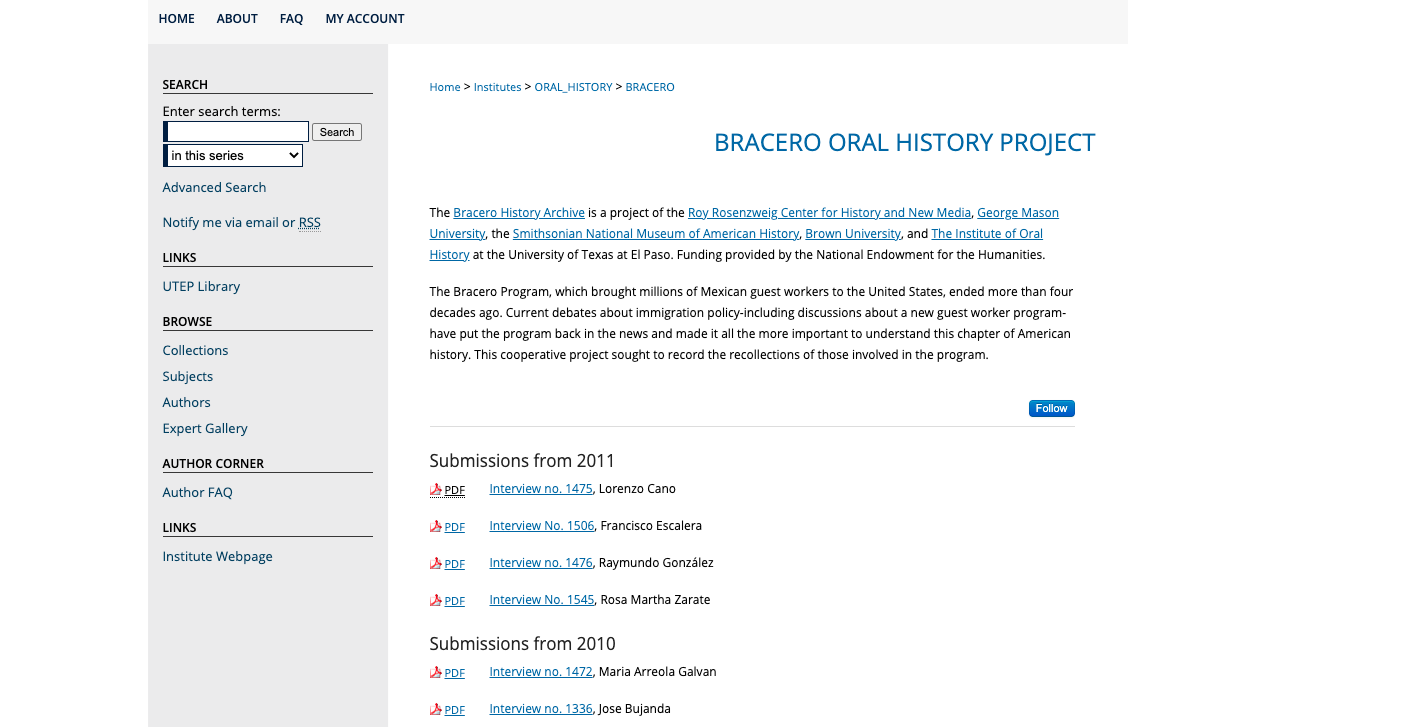
This nomination features three digital oral projects: Voices from the Border (2018-2019), El Paso Food Voices (2018- present), and ‚La Frontera Speaks (2020- present). Each project uses oral history as the core element, combining it with contemporary and historic photographs, and writing and narration by scholars.
The oral histories in our collection are wide-ranging thematically and chronologically. The earliest interviews, from the 1960s and 1970s, feature interviewees who were born in the late 19th and early 20th centuries. An older oral history project, Bracero Archive, amassed hundreds of interviews with men who entered the United States as braceros, temporary workers who came to the U.S. in agriculture and various industries beginning in World War II. Our collection contains oral histories that speak about educational history, migration, entrepreneurship, and daily life on the border. Since 2018, El Paso Food Voices has contributed oral histories that focus on the knowledge, practices, and memories about the food of El Paso’s people. These stories reveal a city’s living history, which is made up of diverse populations, a past with roots spreading in multiple directions, and a dynamic and ever-changing present.
The inaugural video for our Voices from the border series focused on education. In July 2016, we conducted oral histories with several people who had attended segregated so-called Mexican schools in El Paso in the 1950s- 1970s. Ranging in age from their 50s to their 80s, they discussed what it was like to attend school at a time when there was widespread discrimination against Mexican American students. The video is available here. The video has over 600 views to date. Two videos featuring oral histories with former braceros followed. In 2016, in preparation for the 75th anniversary of the beginning of the Bracero program in 1942, we began interviewing former braceros, contributing to an already existing collection. The videos draw from both projects. They may be viewed here (1008 views to date) and here (204 views to date).
Another example of a video from the Voices of the Border series is Uncaged Art. While our collection is historical, we also understand that the present is filled with historical issues. In April 2019, the IOH debuted a museum exhibit of artwork by migrant Central American children who had been detained in an emergency influx center under the US Department of Health and Human Services. They were asylum seekers from Central America who had been either separated from their families through the Zero Tolerance policy of the former administration or had crossed the border alone. Our video includes comments by Freddy, (not his real name), a young Honduran who had been detained in the influx center the previous year. It may be viewed here (477 views to date). Another video, Save Duranguito, is based on oral histories with residents and former residents of El Paso’s first neighborhood that is slated for demolition by the City of El Paso. (248 views to date).
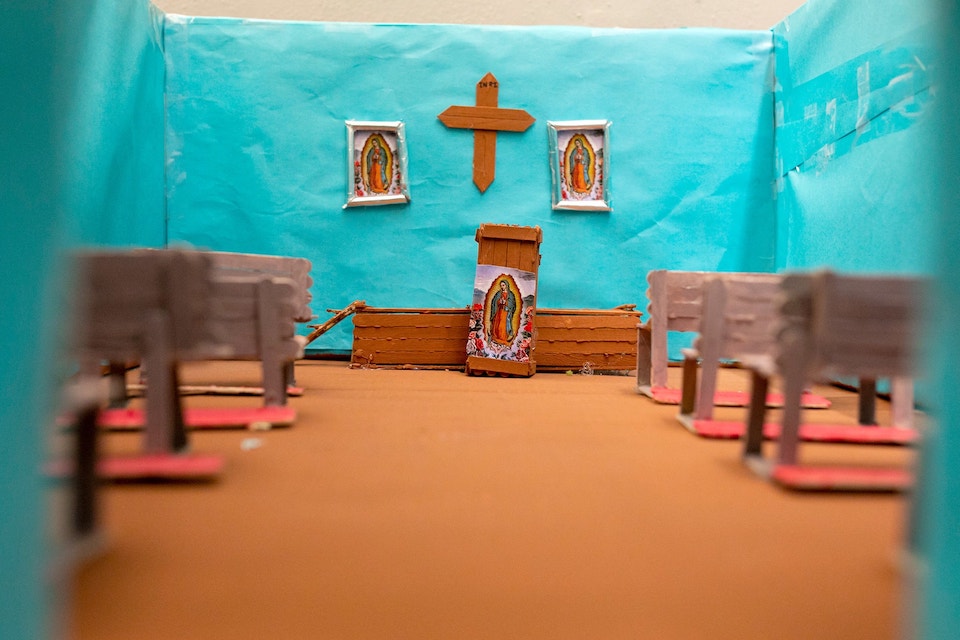
(Photo Courtesy of Ivan Pierre Aguirre for NYTimes)
In 2020, we inaugurated, La Frontera Speaks. Each oral history is attached to two videos. One combines context written by a scholar along with excerpts from the oral history. A second related video highlights the same history while providing additional historical context. We created our first two videos from an oral history with Juan Virgen Diaz, a former bracero who came to the United States as a teenager in 1961. The videos may be viewed here and here. Currently, we have videos in production featuring an interviewee who worked as a clerk at a Bracero processing center in the early 1950s, telling the little-known story of Mexican American women who worked in the Bracero processing centers. We are also producing videos based on an oral history of a woman talking about the lifelong significance of creosote (an important plant in our desert). The scholar for that video is writing her dissertation on the history of creosote. These videos tell the rich and varied history of people on the border and their relationship to international, national, and local events as well as their everyday lives.
El Paso Food Voices collects food stories from home cooks, professional chefs, restaurant owners, educators, and others to learn about our city’s culinary landscape, its histories, cultures, environments, politics, and economics. Each video is created and produced from an oral history conducted by Meredith E. Abarca. Each video is arranged thematically based on topics gathered from an individual’s story. These have ranged from introducing Mexican ingredients to East Indian cooking, reminiscing about long gone El Paso eateries; being born with a cooking gene; reclaiming ancestral foods. The collection also includes recipes created by El Paso residents that range from Sweet Potato Pie,Hot and Spicy Vegetable Curry, to Nohpalli Fruit Salad. As a collection gathered in a YouTube channel, these videos have 455 views to date. You may view videos here: Parul Haribhai’s The Foodie Gene‚ Roman Wilcox’s‚ Cooking with Intention and Responsibility.
We are especially proud that these digital projects telling the stories and histories of border people are the work of a collaboration among faculty, doctoral students, MA students, undergraduate students, and staff. One of our videographers and our MA research assistant are funded through the Mellon EPCC-UTEP Humanities Collaborative, creating a relationship between the El Paso Community College and our university. Digital projects have the potential to create greater access to our collection of oral histories, to provide new resources for educators K-12 and higher education, and to encourage people to record their own stories.
Contributors to the digital projects
Dr. Yolanda Chavez Leyva, Department of History
Dr. Meredith Abarca, Department of English
Kimberly Sumano Ortega, doctoral candidate, Department of History
Ligia Arguilez, doctoral candidate, Department of History
Luis Garcia, MA student, Department of English
Juan Jose Vargas, undergraduate student, Department of Communications
Solomon Contreras, undergraduate student, El Paso Community College
Vianey Alejandra Zavala, manager, Institute of Oral History
Denise Amparan, administrative assistant, Institute of Oral History
Links
UTEP Institute of Oral History Vimeo
UTEP El Paso Food Voices website
Student Excellence Award | Glory Turnbull, St. Mary’s University
The Student Excellence Award honors an individual undergraduate or graduate student that demonstrates overall excellence and contributions to digital library practice.
This year’s Student Excellence Award winner is Glory Turnbull.
By Lindsey Wieck, Assistant Professor and Director of Public History, St. Mary’s University
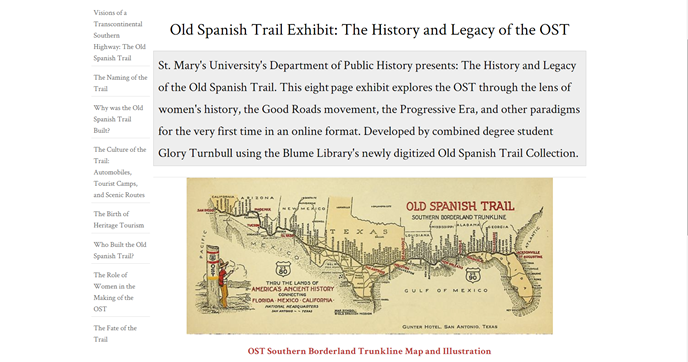
Glory Turnbull (they/them), a combined degree student in Public History (pursuing undergraduate and graduate degrees simultaneously, has been a key member of our project team in the Old Spanish Trail (OST) digitization project since August 2019. During that time, Glory has contributed to a three-student team who have scanned and produced metadata for the nearly 2000 items in the collection. Over and above these responsibilities, Glory helped smooth out our workflow, trained additional undergraduates to produce metadata, and developed a physical and digital version of an exhibit that used these materials. They are currently working to add projects created by undergraduate and graduate students to the archive website to preserve and share this work with others.
This project digitized the Old Spanish Trail (OST) collection, held by the Blume Library at St. Mary’s University [StMU], for the Old Spanish Trail’s centennial celebrations (2015-2029). The digitization of these resources will enable the integration of these primary sources in classrooms and support scholarly research throughout the nation. The collection is significant not only to the history of San Antonio, but also to the entire region, because it linked cities from St. Augustine, Florida to San Diego, California. The OST was built in the 1910s and 1920s as an automobile route. A major waypoint in this coast-to-coast route was San Antonio, Texas where the Old Spanish Trail Association headquarters were located. The association promoted the development of an auto highway throughout the South. The highway encouraged commerce, economic development and social connections among former Spanish colonies that have, to this day, a substantial Hispanic population. The OST had a major impact on the region, including on the development of tourism, highway development, and the built environment of the South.
Digital Archive: Glory played a key role in digitizing the materials and preparing them for upload online. The metadata Glory produced was consistent, clear, and useful. With Glory’s hard work, we were able to successfully scan and organize 100% of the materials in this archival collection. We have currently completed metadata on more than 95% of the items in this collection. We launched the digital archive at https://omeka.stmarytx.edu/ost.
Digital and Physical Exhibit: Glory produced a traveling exhibit that will engage the public in cities along the OST from Florida to California in partnership with the Old Spanish Trail 100 [OST 100], an organization formed in 2004 to recognize and celebrate the 100th anniversary of the OST. Glory also produced a digital version of the exhibit to ensure that it’s accessible to all, wherever they are in the world. As part of the research for this exhibit, Glory contacted experts on the OST and its history to find images, clarify questions, and do additional research. In this work, Glory addressed tough questions including the following: Who was the targeted audience of the OST’s boosterism? Who benefitted from this increase of travelers? What were the racial implications of invoking a romanticized vision of the Spanish past? How were these racial ideas inscribed into the landscape of the OST? In these final products, they tackled tough questions like these while also thoughtfully discussing these topics so as not to isolate OST enthusiasts. Notably, Glory persisted in producing this project throughout the challenges COVID-19 presented to them and to other students. The digital exhibit can be found here. A copy of the physical exhibit is in the attachments section.
Further Related Work: Approximately 100 undergraduate and graduate students in Dr. Teresa Van Hoy’s courses this fall produced mini-research projects using OST materials digitized in this project. Glory produced an OST timeline for one of these courses. Glory is currently working to build a student project showcase that will make all of these projects accessible to researchers, OST enthusiasts, and students throughout the U.S. and beyond.
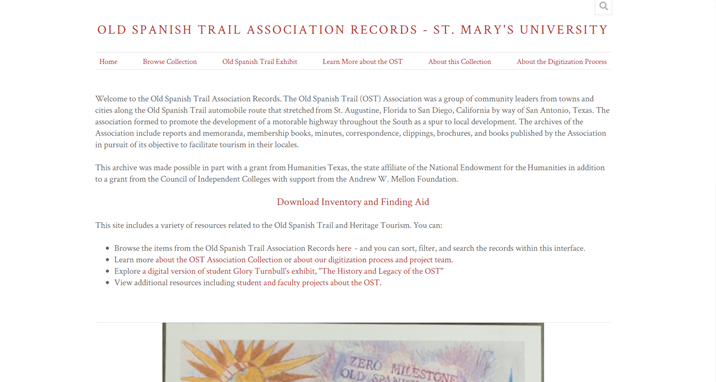
Career Goals: Glory noted that this project helped them achieve marketable skills in archiving and digitization that moves them toward long-term career goals: These skills put me ahead of my undergraduate peers, and this project is the primary reason I was able to land a Collections internship [last] summer. I learned how to work with and train other students, and I’ve even taken a tentative step into curation and exhibit text writing. Glory has used this project to develop valuable skills and projects for their portfolio, taking advantage of all of the opportunities available to learn, grow, and contribute to this project. Currently finishing an M.A. in Public History (Spring 2021 graduation), Glory is sure to continue to use these skills in their next steps as a student of archives and records management beginning Fall 2021. They hope to become an archivist or museum professional in the future.
Overall, Glory has been an essential member of this project team, taking on responsibilities beyond their peers. Glory’s work ethic, attention to detail, and contextualization skills have ensured this project has had a successful result. Without Glory’s contributions, this project would lack much of the rich context infused throughout the archive and exhibit.
Scholarly Communication Award | Taylor Davis-Van Atta, University of Houston Libraries
The Scholarly Communications Award honors the work of an individual or group of academics, including faculty and librarians, who have made significant advances in our understanding of the issues surrounding scholarly communications.
This year’s recipient of the Scholarly Communications Award is Taylor Davis-Van Atta, Director of the Digital Research Commons at University of Houston Libraries.
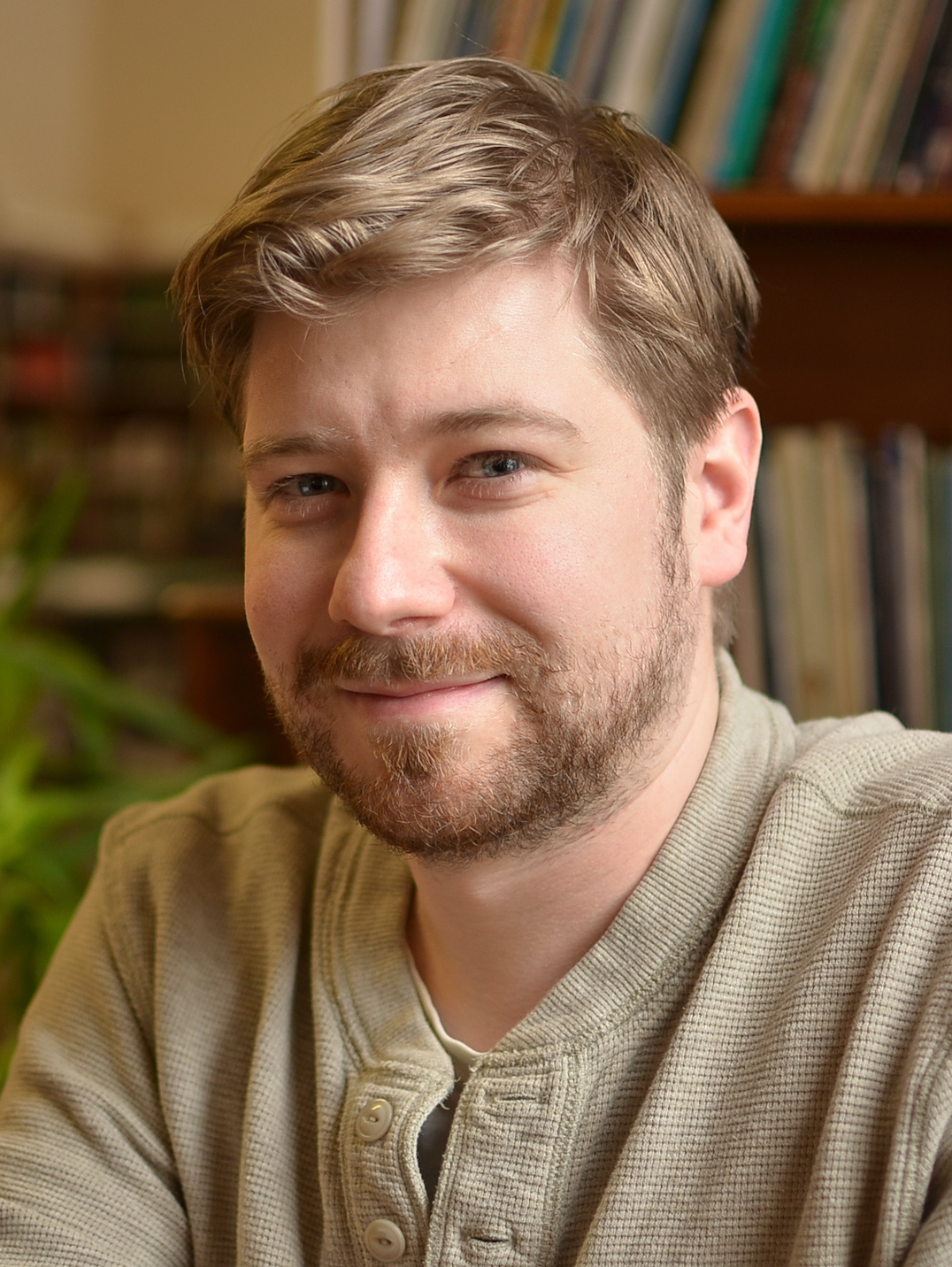
By Anne Washington, University of Houston Libraries
Taylor Davis Van Atta is most deserving of the TDL Scholarly Communication Award for his leadership in transforming UH Libraries scholarly communication services and support. His achievements include significantly growing University of Houston (UH)‚ open access repositories; championing UH Libraries services across campus; and creatively engaging UH colleges and programs to make thousands of student and faculty works openly available.
Taylor joined the University of Houston Libraries in 2017 as the Digital Scholarship Coordinator and in 2020, was promoted to the Director of the Director of the Digital Research Commons. In his roles, he has been, and remains, a driving force behind expanding scholarly communication services for UH faculty and students.
Two of Taylor’s earliest initiatives laid the foundation for expanded services at the libraries: 1) Building out the necessary infrastructure, the Cougar ROAR (Repositories for Open Access), to support scholars in depositing and sharing their open works, and 2) Establishing a CV service at the libraries as a mediate way to deposit faculty works into the IR.
-Cougar ROAR
While UH Libraries used TDL-hosted DSpace as its IR since about 2013, it contained only Electronic Theses and Dissertations. After some initial exploration into the expansion of the IR to include other works, Taylor, as part of the Cougar ROAR project, further established infrastructure for supporting open scholarship and invited in early campus partners. By the end of the project, the Cougar ROAR team had: 1. Established a single page launchpad to our Dataverse repository and our DSpace institutional repository, 2. Created policies and guides for these repositories, 3. Compiled feedback from faculty on these services and materials, 4. Created marketing materials for our services, 5. Started early conversations with UH colleges and departments about scholarly communication services, and 6. Created a roadmap for future open access initiatives.
-Establishing a CV Service
Learning from focus groups with faculty, current literature, and from colleagues in the field, Taylor found that the most likely way we would increase the amount of content in the IR is to follow a mediated submission model. What he brought to life is a service for interested faculty to submit their CV to Libraries staff, who would then locate and upload acceptable versions of the articles to the IR: Assisted Institutional Repository Submissions. He worked in close collaboration with the metadata team to develop sustainable processes to support this service, which is now mainly staffed by student employees. Through this services, we’ve added hundreds of open access articles, posters, presentations, and more.
Taylor built off of the momentum of these initiatives, deepening his relationships with faculty tapped for earlier adoption and forging new relationships with UH programs, departments, and colleges. Taylor championed the use of the IR for a wider breadth of materials including audio/video from UH programs, student research events, and other capstone projects. Because of Taylor’s outreach, we now regularly add hundreds of works to the IR from different programs and events including: the College of Nursing Spring Forum, Undergraduate Research Day posters, Senior Honors Theses, and the Moores School of Music recital recordings (see the full list here in the UH Faculty, Staff, and Student Works collection. The impact of this work cannot be overstated; he was instrumental in centering the IR as a platform for open access works at UH.
Taylor continues to champion Open Access at UH through his ongoing outreach to UH departments and colleges; collaboration with Ariana Santiago, UH Libraries‚ Open Educational Resources Coordinator; and his leadership in Digital Research Services as the Director of the Digital Research Commons. He advocates for fair licensing agreements and for practices that make data and research products openly available and reusable.
These achievements are impressive, of course, but it’s so critical that we also recognize our colleagues that make our working lives better, and Taylor is one of those people. He is a thoughtful collaborator, an advocate for his teams, and what I appreciate most is how he empowers his colleagues and every member of his project
teams. He has supreme confidence in his students and colleagues, which drives creativity and leads to impressive results. Taylor finds ways to bring people into collaborative work and makes it easy for everyone to shine in their strengths. He creates opportunities for staff and students to drive process improvements and is always sure to acknowledge their contributions. Not only does Taylor share his expertise and collaborative spirit with UH, he is actively involved in organizations such as TDL and ACRL. I cannot think of a more deserving individual for the TDL Scholarly Communication Award.
Individual Impact Award | Julianna Barrera-Gomez
The Individual Impact Award honors an individual who has made significant contributions and improvements related to the field of digital curation and digital scholarship. Nominees demonstrated their impact by fostering the development of students and early career professionals, facilitating communities, building infrastructure, and/or contributing to scholarship.
This year’s Individual Impact winner is Julianna Barrera-Gomez, Digital Archivist at University of Texas at San Antonio.
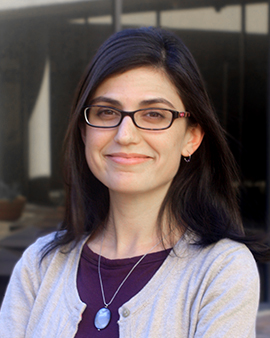
By Amy Rushing, Assistant Dean for Special Collections,University of Texas at San Antonio Libraries Special Collections
Through openness, approachability, enthusiasm for collaboration, and willingness to share her valuable knowledge and expertise, Julianna has made a positive impact on the digital curation community, particularly in Texas.
As a member of the TDL Texas Archivematica Users Group (A-TEX) Steering Committee, Julianna plays an influential role in leading digital preservation efforts, decisions, and practices at UTSA and throughout Texas. She has played a key role in helping plan in-person meetings and networking events, answering questions, and contributing her expertise through panels and webinars. She has a distinctive situation and unique experiences to share with the TDL community, particularly in the area of digital preservation. As the only longstanding administrator of the ArchivesDirect digital preservation platform in Texas, Julianna’s knowledge and expertise have both informed and influenced the A-TEX steering committee’s efforts in serving the Archivematica community around the state. She has presented on her work numerous times in different venues which has impacted many local preservation decisions within the community.
At UTSA, Julianna spearheaded the formation of the Libraries Digital Stewardship Governance Group. Governance Group members are mainly non-archivists from every area in the Libraries who have a role in creating or managing digital content. Julianna’s leadership is helping the Libraries build a collective knowledge of the challenges and considerations in digital preservation so that this knowledge doesn’t just reside in Special Collections. She presents digital preservation concepts in an accessible way and provides real-world, relatable examples that are easily digestible by colleagues who do not work in the digital curation field.
Through her service, Julianna makes significant contributions in building a sense of unity and purpose. She is an advocate for smaller institutions that are often operating with restricted resources like small staff sizes, a lack of specialized expertise, inadequate technical infrastructures, and/or limited budgets.
She is currently co-chair of the Texas Archival Resources Online (TARO) Standards Committee. Julianna exhaustively researched metadata standards to empower software developers, as well as other TARO committees, to capitalize on the new website’s ability to make finding aids even more discoverable. This led to detailed revisions of TARO’s EAD Best Practice Guide. She also helped lead the charge on laying groundwork for TARO’s conversion to EAD3.
TDL Service Award | Colleen Lyon, Dianna Morganti, John Watts, and Jessica Trelogan
The TDL Service Award is given at the discretion of the Texas Digital Library to an individual or group at a member institution who do exceptional work in the service of the Texas Digital Library consortium.
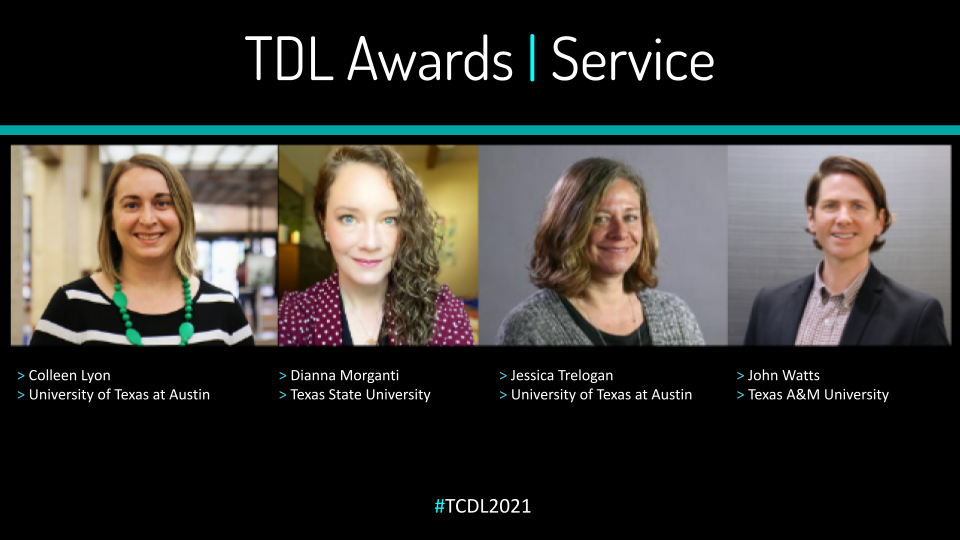
This year we are pleased to recognize Colleen Lyon, Dianna Morganti, John Watts, and Jessica Trelogan.
By Courtney Mumma
Each year, the Texas Digital Library honors a winner from among our TDL members (an individual or a group) who have made outstanding and meaningful contributions to the TDL consortium and its members. The 2021 recipient of the 2021 Texas Digital Library Service Award, the Carpentries Pilot Project Team. They are Dianna Morganti at Texas State University, Colleen Lyon and Jessica Trelogan at UT Austin, and John Watts at Texas A&M University.Their collaborative work on the foundation, management, and assessment of the TDL Carpentries pilot has been exemplary. Training Carpentries instructors from among our TDL member institutions will serve to expand data expertise across Texas and the region. TDL is grateful for your efforts in leading this project from start to finish – from proposing the Carpentries pilot to TDL’s Governing Board and coordinating the launch and equitable selection of trainees, to building a community of instructors, hosting and organizing several workshops, and laying the groundwork for continued Carpentries engagement in Texas.Congratulations Colleen, Dianna, Jessica and John, for your service to TDL!
We would also like to recognize our nominees for the 2021 TDL Awards
- COVID-19: The Hilltop Perspective, St. Edwards University
- C.L. Sonnichsen Special Collections Department, The University of Texas at El Paso Library/Fanny Zlabovsky – National Council of Jewish Women Case Files Digitization Project
- William J. Hill Texas Artisans and Artists Archive
- Archiving for the Future: An Open Educational Resource
- University of North Texas Digital Libraries’ Digital Newspaper Unit
- Voices of SMU Oral History Collection
- Darryl Stuhr, Director of Digitization and Digital Preservation, Baylor University Libraries
- Darryl Tocker, The Tocker Foundation
- Annie Wu,Head, Metadata and Digitization Services, University Libraries, University of Houston
- Cushing Library / Bryan + College Station Public Library System Summer Reading Program digital scavenger hunt
- Stephen Sloan, Waco History App
- Constitutions of Texas, 1824-1876, Tarlton Law Library
- Scholarly Impact Service, University of North Texas Libraries
- Emily Vinson, University of Houston Libraries Special Collections
- Austin Museum of Popular Culture Digital Retooling
Learn more about the TDL Awards and read about past years’ winners.